In the previous post The Desiccation: Keeping the code DRY we have described the optional closure parameter to allow developers to break…
Groovy DSL Builders #6: The Expectations
In the previous post The Desiccation: Keeping the code DRY we have explained why we should provide an optional closure parameter to allow developers to break big DSL definitions into smaller chunks. In this part, we take a look at the most common problem with any Groovy DSL which is mismatched expectation what scope uses nested closures.
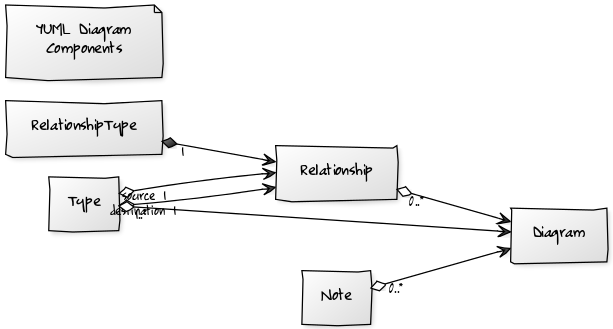
YUML.me Diagram’s Diagram
There is actually yet another player than delegate in the game of closure’s property and method resolution. It’s called owner and it points to the object where the closure was defined. You need to pay attention to the owner as soon you start nesting closures more than one level.
Let’s take a look at simple example. Current DSL also allows the following notation:
@CompileStatic
private static Diagram buildDiagramWithInternalMethodCalls() {
Diagram._build_ { note 'YUML Diagram Components' type 'Diagram', {
has _one_ to _many_ type 'Type' _// "notes" is defined in the owner_ has _zero_ to _many_ type _notes_ has _zero_ to _many_ type 'Relationship' }
type 'Relationship', {
has _one_ type 'Type' called 'source' has _one_ type 'Type' called 'destination' owns _one_ type 'RelationshipType' }
}
}
private static String getNotes() {**return 'Note' }Using references to properties and methods from the outer scope such as the propertynotes is very natural but it may result in unexpected behaviour if you don’t pay attention to what is the actual owner of the closure. Unless you handle the nested closures carefully then by default the owner of the nested closure passed into type method is actually the delegate of the surrounding closure which means DefaultDiagramin our situation. And DefaultDiagram already defines property notes even it is not visible through DiagramDefinition interface.
To work around this you need to forward the top level owner to any nested closure:
public static Diagram build(
    @DelegatesTo(
        value = cz.orany.yuml.model.dsl.DiagramDefinition.class,
        strategy = Closure.\1    )
Closure d ) {
DefaultDiagram diagram = new DefaultDiagram(d.getOwner());DefaultGroovyMethods._with_(diagram, d); return diagram;
}We keep the original owner and we will pass it to the any nested closure:
@ToString
@PackageScope
@CompileStatic
@EqualsAndHashCode
class DefaultDiagram implements Diagram, DiagramDefinition {

    private final Object owner;
**// other fields**
DefaultDiagram(Object owner) { this.owner = owner
}// other methods
@Override
DefaultType type(
String name, @DelegatesTo(
value = TypeDefinition.class,
strategy = Closure.\1 )
@ClosureParams(
value = SimpleType.class,
options = "cz.orany.yuml.model.dsl.TypeDefinition" )
Closure<? extends DiagramContentDefinition> builder
) {
DefaultType type = typesMap\[name\] withSameOwner type, builder return type
}
protected <V, T> V withSameOwner(T self, Closure<V> closure) {
final Closure<V> clonedClosure = closure.rehydrate( self, owner, closure.thisObject )
clonedClosure.setResolveStrategy(Closure.\1); clonedClosure.call(self)
} }We can use method rehydrate which was created for very different reasons but it is very helpful to create a clone of the closure with a different owner than the original one. You can use it to change the owner of the nested closure calls. After this change, the original snippet would return expected results bypassing the notes property in DefaultDiagram and using getNotes method in the surrounding class.
The code is available on GitHub under 06-owner tag:
git clone https://github.com/musketyr/yuml-dsl-builder.git
cd yuml-dsl-builder
git checkout 06-owner
In the next part The Extension: Designing your builder DSL for extendability we are going to provide extension points to our DSL to let developers provide extra functionality atop our basic DSL library.
Contents
- The Concept: The core concept of builders
- The Essence: The closures’ basics
- The Aid: Using the annotations for static compilation
- The Disguise: Hiding the implementation of the builder API
- The Desiccation: Keeping the code DRY
6. [The Expectations: _The importance of handling closures’ owner properly_](https://medium.com/p/83ced4b8f2b)