In the previous post The Expectations: The importance of handling closures’ owner properly we solved the problem with the scoping of…
Groovy DSL Builders #7: The Extension
In the previous post The Expectations: The importance of handling closures’ owner properly we solved the problem with the scoping of nested closures. In this post, we are going to provide an extension point to allow developers to create extra functionality atop the simple DSL library.
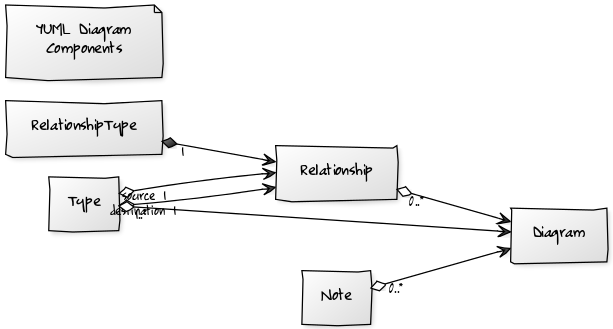
YUML.me Diagram’s Diagram
One of the key features of any software system is the ability to react to changes. Doesn’t matter how much you try to anticipate every possible use case but you will definitely miss at least one. It is good to think about allowing the developers to extend your builder DSL.
In Groovy, the simplest possible way how to extend the DSL is to use extensions modules. If you expose a method which is generic enough to handle all of the possible scenarios then you open your DSL for developers who may have an idea how to create a simple shortcut to some more complex call.
Let’s start simple. Following extension class helps you to add stereotype method besides the originally provided type method:
public class StereotypeExtensions {

    public static TypeDefinition stereotype(
DiagramDefinition diagram,
String name ) {
return diagram.type("<<" \+ name + ">>");
}
public static RelationshipDefinition stereotype( AggregationOrCompositionBuilder builder,
String name ) {
return builder.type("<<" \+ name + ">>");
}
public static RelationshipDefinition stereotype( InheritanceBuilder builder,
String name ) {
return builder.type("<<" \+ name + ">>");
}
}To enable the class as extension module you need to create a file META-INF/services/org.codehaus.groovy.runtime.ExtensionModule with the following content:
moduleName=yuml-extra
moduleVersion=0.1.0
extensionClasses=cz.orany.yuml.stereotype.StereotypeExtensions
staticExtensionClasses=
Then you are able to use the stereotype method within your DSL:
note 'YUML Diagram Components'
stereotype 'Diagram' has _one_ to _many_ stereotype 'Type'
stereotype 'Diagram' has _zero_ to _many_ stereotype 'Note'
stereotype 'Diagram' has _zero_ to _many_ stereotype 'Relationship'

stereotype 'Relationship' has _one_ stereotype 'Type' called 'source'
stereotype 'Relationship' has _one_ stereotype 'Type' called 'destination'
stereotype 'Relationship' owns _one_ stereotype 'RelationshipType'
Which will produce the following output:
\[note: YUML Diagram Components\][<
[<
[<
[<
[<
\[<<RelationshipType>>\]++1->\[<<Relationship>>\]But what if the new language feature goes beyond the current functionality. In that case, you should create a helper interface which will allow developers to plug into the build mechanism. I have simply called the interface DiagramHelper. The diagram will need to store the information provided by the helper in some generic storage such as a plain Map<String, Object> metadata map. Finally, you need to expose an extension point for the helpers.
Here are the pieces of code which handle the helpers:
@Override
public <H extends DiagramHelper, R> H configure(
    @DelegatesTo.Target("helper")
Class<H> helper, @DelegatesTo(
value = DelegatesTo.Target.class,
target = "helper",
strategy = Closure.\1, genericTypeIndex = 0 )
@ClosureParams(FirstParam.FirstGenericType.class)Closure<R> configuration ) {
H helperInstance = (H) helperMap.computeIfAbsent(helper, { helper.newInstance()
})
DefaultGroovyMethods._with_(helperInstance, configuration) return helperInstance
}
void postprocess() {
for (DiagramHelper helper : helperMap.values()) {
metadata.putAll(helper.metadata)
}
}It’s actually pretty easy to create such an extension point. In the example, you can see the different usage of DelegatesTo annotation, this time using the Target and genericTypeIndex to point to the generic type of the method. Method postprocess is called after the diagram is built, allowing the helpers to supply the metadata.
Now let’s say we want to learn our YUML DSL to be able to also define the properties of the classes. This is a feature which is already present in YUML but we haven’t implemented it directly to keep the example as trivial as possible. So the desired notation should look like on the following example:
note 'YUML Diagram Components'
type 'Diagram', {
    has _one_ to _many_ type 'Type'    has _zero_ to _many_ type _notes_    has _zero_ to _many_ type 'Relationship'
}

type 'Relationship', {
    has _one_ type 'Type' called 'source'    has _one_ type 'Type' called 'destination'    owns _one_ type 'RelationshipType'
}

type 'Type', {
    property name: 'string'
}
The new property method accepts a map having names of the properties as keys and types of the properties as values. To extend the DSL we need to create an yet another extension class:
@CompileStatic
class PropertiesDiagramHelperExtensions {

    static TypeDefinition property(
TypeDefinition typeDefinition,
String type,
String name
) {
typeDefinition
.diagramDefinition
.configure(PropertiesDiagramHelper) {
it.addProperty(typeDefinition.name, type, name) }
return typeDefinition
}
static TypeDefinition property( TypeDefinition typeDefinition,
Map<String, String> properties
) {
typeDefinition
.diagramDefinition
.configure(PropertiesDiagramHelper) {
it.addProperties(typeDefinition.name, properties) }
return typeDefinition
}
}The extension class uses the extension point method configure to configure an instance of PropertiesDiagramHelper which will hold the properties for us and during the call to postprocess it will add the properties to the diagram as metadata. You may notice that the TypeDefinition now holds the reference to the DiagramDefinition. If you want to create extendible DSL it is very useful to provide references to objects which are logically one level up in the tree so the developers writing the extensions can traverse the tree more easily.
The extension would be useful without the component which understands the metadata. The YumlPrinter can get the information about the properties while printing the type:
private String print(Diagram diagram, Type type) {Map<String, String> properties =
PropertiesDiagramHelper._getProperties_(diagram, type); if (properties.isEmpty()) {
return String._format_("\[%s\]", type.getName());
}String propertiesFormatted = properties
.entrySet()
.stream() .map((e) -> e.getKey() + ":" \+ e.getValue())
.collect(Collectors._joining_(";"));
return String._format_(
"\[%s|%s\]", type.getName(),
propertiesFormatted
); }
This would produce the expected output including the properties:
\[note: YUML Diagram Components\][Type|name:string]<>1..*->[Diagram]
[Note]<>0..*->[Diagram]
[Relationship]<>0..*->[Diagram]
[Type|name:string]<>source 1->[Relationship]
[Type|name:string]<>destination 1->[Relationship]
\[RelationshipType\]++1->\[Relationship\]The code is available on GitHub under 07-extensions tag:
git clone https://github.com/musketyr/yuml-dsl-builder.git
cd yuml-dsl-builder
git checkout 07-extension
In the next part The Resignation: Rewriting the Groovy DSL builder into Java we take a look what how to allow plain old Java developers to also use your DSL.
Contents
- The Concept: The core concept of builders
- The Essence: The closures’ basics
- The Aid: Using the annotations for static compilation
- The Disguise: Hiding the implementation of the builder API
- The Desiccation: Keeping the code DRY
- The Expectations: The importance of handling closures’ owner properly
7. [The Extension: _Designing your builder DSL for extendability_](https://medium.com/p/d612fd261471)