In the previous post The Resignation: Rewriting the Groovy DSL builder into Java we migrated our Groovy DSL builder into Java. In this…
Groovy DSL Builders #9: The Navigation
In the previous post The Resignation: Rewriting the Groovy DSL builder into Java we migrated our Groovy DSL builder into Java. In this part we are going to declare some methods accepting named parameters in our DSL.
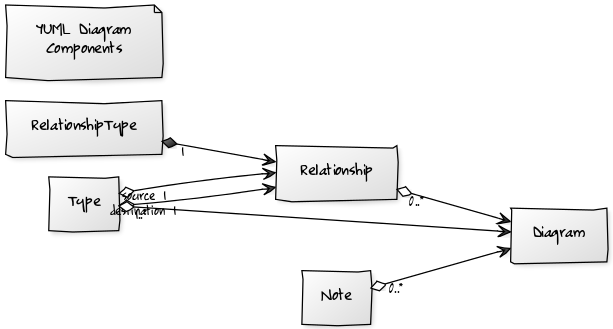
YUML.me Diagram’s Diagram
If you have read Groovy Developer Manifesto you know I consider overusing maps in Groovy as one of the biggest developers’ sins. On the other hand, I can see how appealing can named arguments be. Groovy 2.5 makes using Map arguments bit less painful with a set of Named* annotations.
First of all, let’s summarise the situations in which it is meaningful to use Map to collect named arguments in your DSL.
- There are some fields marked
finalinside your definition objects and therefore the objects have no zero-args constructor. In that case, it may be useful to create a method with a signaturemethod(Map requiredArgs, Closure optionalProperties). - There is a method with ambiguous and/or optional arguments
There is no relevant method which would benefit for the first use case in our YUML DSL but methods source and destination inside therelationship definition easily fits the second one. It might be more readable if we can specify cardinality or title as named parameters:
aggregation('Customer', 'Order') {
    source cardinality: '1'    destination cardinality: '0..\*', title: 'orders'
}
Now let’s take a look at how the new methods are implemented:
public static RelationshipDefinition source(RelationshipDefinition self, @NamedParams({
@NamedParam(value = \1, type = String.class),
@NamedParam(value = \1, type = String.class)
})Map<String, String> cardinalityAndTitle ) {
return self.source(
cardinalityAndTitle.get(\1),
cardinalityAndTitle.get(\1)
);
}
public static RelationshipDefinition destination(RelationshipDefinition self, @NamedParams({
@NamedParam(value = \1, type = String.class),
@NamedParam(value = \1, type = String.class)
}) Map<String, String> cardinalityAndTitle ) {
return self.destination(
cardinalityAndTitle.get(\1),
cardinalityAndTitle.get(\1)
);
}New methods source and destination were added to the extension class. Although there is more annotations related to named arguments only NamedParams and NamedParam are the important ones. Annotations such as NamedDelegate or NamedVariant are just Groovy AST transformation helping to build the list of the named arguments. Using NamedParams will bring you additional static compilation checks as you can mark the parameter as required and since Groovy 2.5.5 you should be also able to also mark NamedParams not to accept any other keys then the declared ones. But still, for example at the time of writing IntelliJ IDEA doesn’t seem to benefit from this feature so it won’t give you the desired hints so using named arguments should still be considered as a tool of the last resort.
The code is available on GitHub under 09-named-parameters tag:
git clone https://github.com/musketyr/yuml-dsl-builder.git
cd yuml-dsl-builder
git checkout 09-named-parameters
The last part of this series The Conclusion: The checklist for Groovy DSL builders’ authors provides the check list for creators of the new Groovy builder DSL as well as for revisiting exiting ones.
Contents
- The Concept: The core concept of builders
- The Essence: The closures’ basics
- The Aid: Using the annotations for static compilation
- The Disguise: Hiding the implementation of the builder API
- The Desiccation: Keeping the code DRY
- The Expectations: The importance of handling closures’ owner properly
- The Extension: Designing your builder DSL for extendability
- The Resignation: Rewriting the Groovy DSL builder into Java
9. [The Navigation: _Using the annotations for named parameters_](https://medium.com/p/d065f0253e98)